Mini Fruit Cross Stitch Patterns: Six Tiny Fruits to Stitch
Six original mini fruits on a 9 x 10 grid: strawberry, cherries, lemon, pear, apple and watermelon. Full cross stitches only, with a chart, color key and size table.
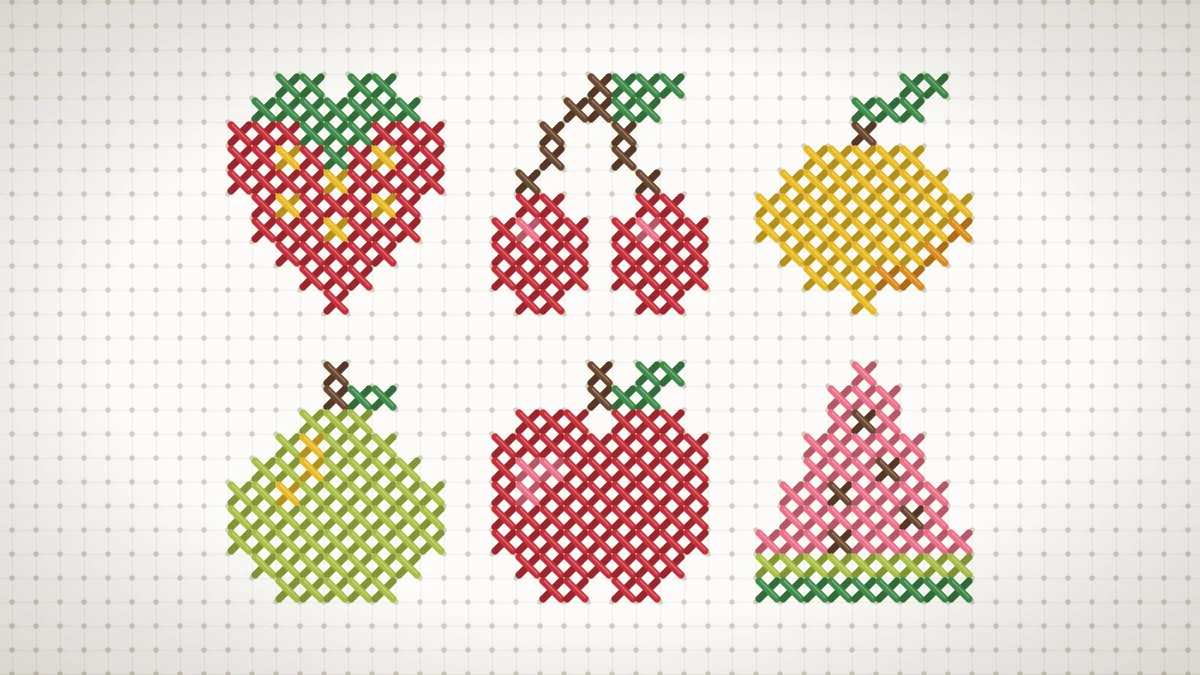
At a glance
Materials
- 14-count white Aida with 2 to 3 in (5 to 8 cm) spare on each side of the design
- Size 24 tapestry needle
- Stranded cotton floss in strawberry red, watermelon pink, leaf green, pear green, lemon yellow, golden orange and stem brown
- Small sharp scissors
- Embroidery hoop, optional
Six small fruits, each no bigger than a thumbnail on 14-count fabric: these mini fruit cross stitch patterns are made for the bright ends of floss that are too short for anything larger. The set holds a strawberry, a pair of cherries, a lemon, a pear, an apple and a wedge of watermelon. Every one is an original design drawn on the same 9 x 10 grid, so they line up neatly whether you stitch one or all six.
What Is in the Fruit Set
The sheet has two rows of three. The top row holds the strawberry, the cherries and the lemon; the bottom row holds the pear, the apple and the watermelon.
| Fruit | Main color | Details |
|---|---|---|
| Strawberry | Strawberry red | Leaf green cap, lemon yellow seeds |
| Cherries | Strawberry red | Pink highlights, brown stems, one green leaf |
| Lemon | Lemon yellow | Golden orange shading, brown stem, green leaf |
| Pear | Pear green | Yellow highlight, brown stem, green leaf |
| Apple | Strawberry red | Pink highlight, brown stem, green leaf |
| Watermelon | Watermelon pink | Brown seeds, pale and dark green rind |
All six use full cross stitches only. There is no backstitch, so the shapes rely on color alone, which is why a clean white fabric suits them so well.
The Chart
One square is one cross stitch over one Aida block. The heavier lines fall every ten squares and the arrows on the edges mark the center of the sheet.
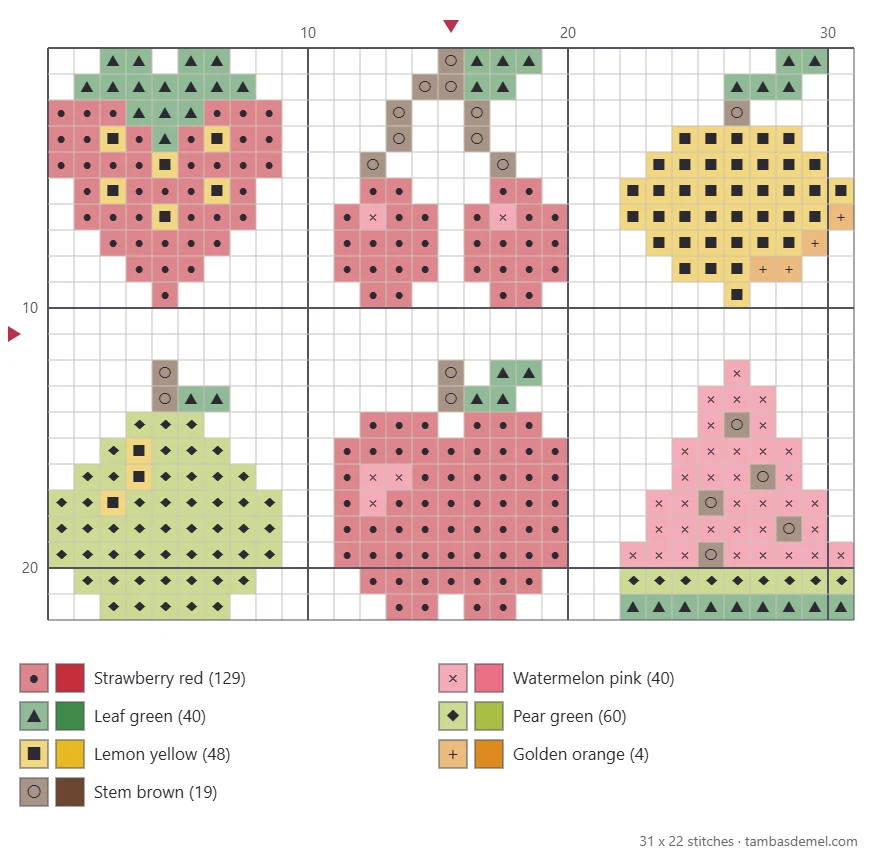
The full sheet is 31 x 22 stitches. It contains 340 full crosses and calls for 7 floss colors.
| Symbol | Color | Stitches |
|---|---|---|
| ● | Strawberry red | 129 |
| × | Watermelon pink | 40 |
| ▲ | Leaf green | 40 |
| ◆ | Pear green | 60 |
| ■ | Lemon yellow | 48 |
| + | Golden orange | 4 |
| ○ | Stem brown | 19 |
The names in the key are plain descriptions. Match them from your own stash by eye. Two pairs deserve a moment of care: the red and the pink should be clearly different in depth, and the pear green should be noticeably lighter and yellower than the leaf green. If two shades look alike in the skein they will look identical once stitched.
Finished Size on Different Fabrics
Stitched as a complete sheet on 14-count Aida, the design measures 2.2 x 1.6 in (5.6 x 4.1 cm). The table covers the other common counts and suggests how large to cut the fabric.
| Aida | Finished design | Fabric to cut (3 in spare per side) |
|---|---|---|
| 11-count | 2.8 x 2 in (7.1 x 5.1 cm) | 9 x 8 in (22.9 x 20.3 cm) |
| 14-count | 2.2 x 1.6 in (5.6 x 4.1 cm) | 8.5 x 8 in (21.6 x 20.3 cm) |
| 16-count | 1.9 x 1.4 in (4.8 x 3.6 cm) | 8 x 7.5 in (20.3 x 19.1 cm) |
| 18-count | 1.7 x 1.2 in (4.3 x 3 cm) | 8 x 7.5 in (20.3 x 19.1 cm) |
One fruit on its own is nine stitches wide and ten tall. On 14-count that is about 0.65 x 0.7 in (1.6 x 1.8 cm); on 18-count it shrinks to 0.5 x 0.55 in (1.3 x 1.4 cm), small enough for a tiny tag.
Materials and Setup
For 14-count Aida, use two strands of stranded cotton and a size 24 tapestry needle. Three strands and a size 22 needle suit 11-count; two strands and a size 26 needle suit 16-count. Stranded cotton comes as six loosely twisted strands, so separate them one at a time and put two back together before threading. The embroidery floss guide shows how to do that without tangles.
Keep working lengths to about 18 in (45 cm). For a single fruit, even that is more than most colors need, and short ends from earlier projects are ideal.
Tip
Two strands make an even number, so you can use a loop start: fold one long strand in half, thread the two cut ends through the needle and catch the loop on the back with the first stitch.
How to Stitch Each Fruit
Strawberry
Begin with the green cap, then fill the red body row by row, leaving the seed squares empty. Drop the yellow seeds in afterward. Each seed is a single stitch, so anchor the yellow under the back of the red stitches and travel there between seeds.
Cherries
Stitch the two red cherries first. Each has one pink stitch near its top left for a highlight. The brown stems rise from each cherry and meet at the top, and several of the stem stitches touch only at their corners, so count each one. The green leaf sits to the right of the point where the stems join.
Lemon
Fill the yellow body, then add the golden orange along the lower right edge. That small curve of darker color is what makes the lemon look round instead of flat. Finish with the brown stem stitch and the leaf.
Pear
The pear is narrow at the top and wide at the base. Work the pear green from the bottom up, where the rows are longest and easiest to count, then add the three yellow highlight stitches on the left side.
Apple
The apple has a notch at the top and a matching one at the bottom, each a single empty square in the middle of the row. Stitch the red, add the three pink highlight stitches, then the stem and leaf.
Watermelon
Start with the two straight rind rows at the bottom: dark green on the lowest row and pear green just above it. Build the pink wedge upward from there, narrowing to a single stitch at the tip, and place the brown seeds last.
General Stitching Order
- Cut the fabric with 2 to 3 in (5 to 8 cm) of spare cloth on every side.
- Fold it in half both ways to find the center and mark it with a pin.
- Count from the center to the fruit you want to begin with. The guide to counting cross stitch explains how to cross empty gaps without drifting.
- Work each fruit’s main color first, then the highlights, stems, leaves and seeds.
- Keep every top leg slanting in the same direction across the whole sheet.
- Secure each thread by running it under three or four stitches on the back, as shown in how to start and finish a thread.
Watch out
Do not carry dark brown or red thread across empty white fabric from one fruit to the next. The strand can show through from the front. End the thread and start again at the next fruit.
Ideas for Using Mini Fruits
- Jam jar toppers: one fruit centered on a circle of Aida, tied over a lid with string, labels homemade preserves at a glance.
- Kitchen towel band: repeat one fruit, or alternate two, in a row along a strip of Aida stitched to a plain towel.
- Recipe card or gift tag: a single fruit glued to card stock makes a small handmade label.
- Six-fruit mini sampler: stitch the sheet exactly as charted and frame it or mount it in a small hoop.
The fruits share their scale with the nine designs in the mini cross stitch motifs set and with the mini mushroom pattern, so the three can be mixed freely on one piece of fabric.
Changing Colors and Fabric
A green apple needs only one change: swap the red for the pear green and use the yellow for the highlight. The cherries turn into dark cherries with a deeper wine red, and the lemon becomes a lime with two shades of green in place of the yellow and orange.
White fabric shows the lemon yellow best. On cream or oatmeal Aida the yellow loses contrast, so choose a stronger, warmer yellow or leave the lemon out of the set.
Frequently asked questions
Which mini fruit is the easiest to start with?
The apple and the pear are the simplest because each is one solid shape with a few highlight stitches. The cherries need the most counting, since the thin stems are made of stitches that meet only at their corners.
Can the fruits be stitched on colored Aida?
Yes, as long as every thread color still contrasts with the fabric. Pale blue sets off the reds and yellows well. Green fabric tends to swallow the leaves, the pear and the watermelon rind.
How much floss do the mini fruits need?
Very little. Each fruit is only nine stitches wide and ten tall, so short leftover lengths are usually enough for the smaller colors. One skein of each color is far more than the whole sheet needs.

