Geometric Cross Stitch Pattern: A Repeating Diamond Tile
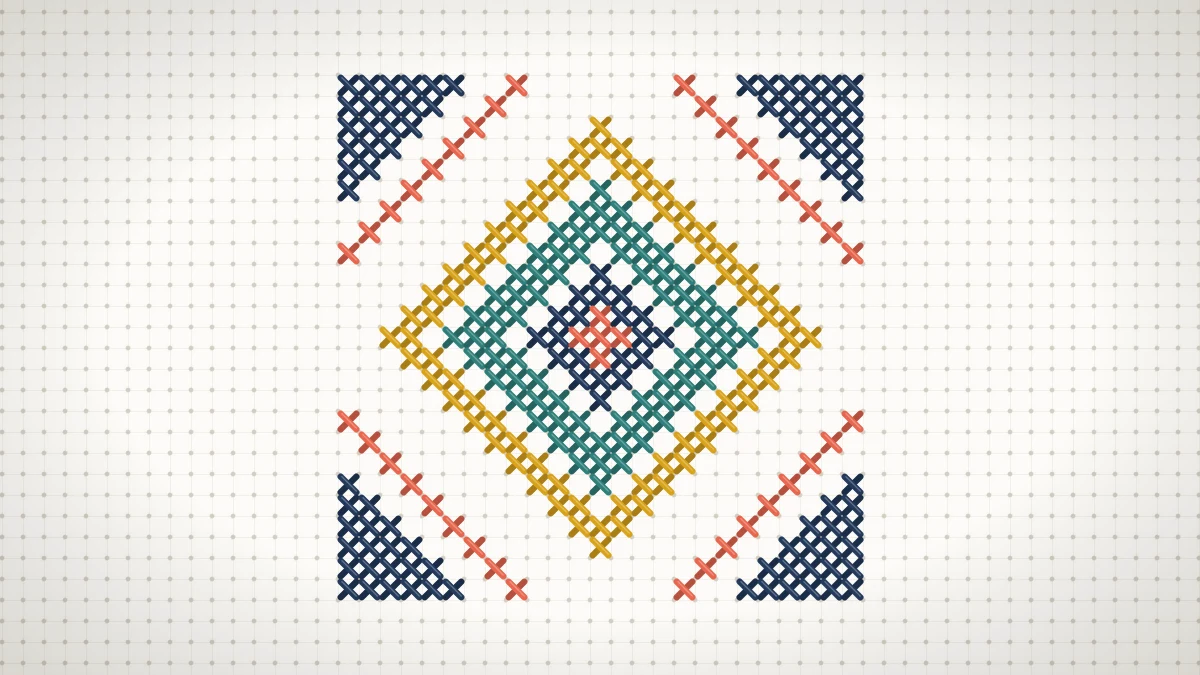
An original modern tile of nested diamonds and corner triangles in navy, teal, mustard and coral. Stitch one tile on its own or repeat it edge to edge for a seamless pattern.
At a glance
Materials
- 14-count white Aida with 3 in (8 cm) spare on each side of the planned layout
- Size 24 tapestry needle
- Six-strand cotton floss in navy, teal, mustard and coral
- Small sharp scissors
- Embroidery hoop or frame (optional)
Clean lines, flat color and a shape that locks into itself when repeated: this geometric cross stitch pattern is a single square tile of nested diamonds with a triangle in each corner. One tile is 25 x 25 stitches, uses 4 colors and contains 293 full crosses. Stitch it once for a small framed piece, or repeat it edge to edge and watch the corner triangles join into a second set of diamonds between the first.
There is no backstitch and no shading. Every edge is a 45 degree diagonal, one stitch over and one stitch down, which makes the tile surprisingly restful to work once the first ring is in place.
How the Tile Is Designed
Reading from the center outward, the tile has six parts:
- a small coral diamond in the exact middle;
- a navy ring wrapped tightly around it;
- one row of bare fabric, then a wide teal band;
- another row of fabric, then a narrower mustard band whose four tips stop just short of the edges of the tile;
- a thin coral diagonal line crossing each corner;
- a solid navy triangle filling each corner.
The gaps of unstitched fabric are part of the design. They separate the bands so that each color stays crisp, and they keep the tile from feeling heavy. On white Aida the gaps read as white lines; on a colored fabric they become a fifth color for free.
The tile is symmetrical left to right and top to bottom. Whatever you stitch in one quarter is repeated, mirrored, in the other three, which makes mistakes easy to spot.
Materials
- 14-count white Aida, cut with 3 in (8 cm) of spare fabric on every side of the planned design
- Size 24 tapestry needle
- Six-strand cotton floss in the four colors of the key
- Small sharp scissors
- An embroidery hoop or frame large enough to hold the whole tile, optional but helpful
Use 2 strands of floss on 14-count. Geometric designs depend on solid, even coverage, so if the fabric shows through the navy, check that the strands are lying side by side rather than twisted around each other.
The Chart
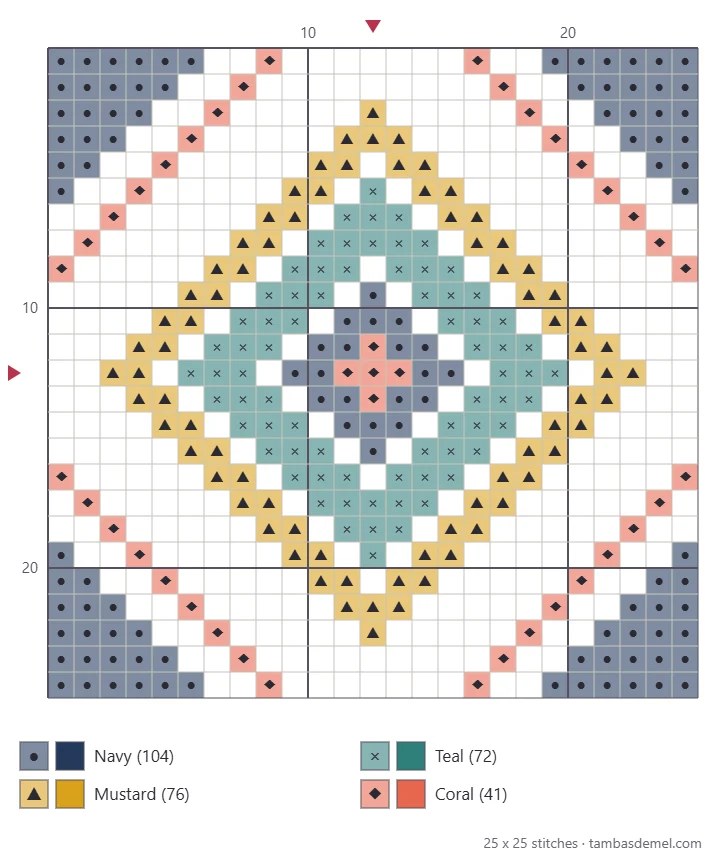
The center arrows cross on the middle stitch of the coral diamond. Heavier grid lines every ten squares help with longer counts, but on this chart you rarely need them: each ring is counted from the ring before it.
Color Key
| Symbol | Color | Stitches |
|---|---|---|
| ● | Navy | 104 |
| × | Teal | 72 |
| ▲ | Mustard | 76 |
| ◆ | Coral | 41 |
The palette pairs two cool, deep colors with two warm, bright ones. When choosing floss from your stash, keep that balance: navy and teal should be clearly different from each other at arm’s length, and the mustard should be strong enough to hold its own next to them. A mustard that is too pale turns into a gap rather than a band.
Finished Size
A single tile stitched on 14-count Aida measures 1.8 x 1.8 in (4.6 x 4.6 cm).
| Aida | Finished design | Fabric to cut (3 in spare per side) |
|---|---|---|
| 11-count | 2.3 x 2.3 in (5.8 x 5.8 cm) | 8.5 x 8.5 in (21.6 x 21.6 cm) |
| 14-count | 1.8 x 1.8 in (4.6 x 4.6 cm) | 8 x 8 in (20.3 x 20.3 cm) |
| 16-count | 1.6 x 1.6 in (4.1 x 4.1 cm) | 8 x 8 in (20.3 x 20.3 cm) |
| 18-count | 1.4 x 1.4 in (3.6 x 3.6 cm) | 7.5 x 7.5 in (19.1 x 19.1 cm) |
Because the finished size is the stitch count divided by the fabric count, the tile is easy to scale. The Aida fabric guide covers the matching needle size and number of strands for each count.
Stitching One Tile Step by Step
- Find and mark the center of the fabric. Fold it in half both ways; the center stitch of the coral diamond goes where the folds cross.
- Stitch the coral diamond. It is five stitches in the shape of a plus sign: one in the middle and one on each side of it.
- Stitch the navy ring. It surrounds the coral completely and is two stitches thick on every diagonal. Work around it one quarter at a time.
- Skip one row and stitch the teal band. Count the gap from the outer tip of the navy ring along the center row: one empty square, then teal. From that first stitch the band steps diagonally, one over and one up.
- Skip one row and stitch the mustard band in the same way.
- Stitch the four navy corner triangles. Count from the tips of the mustard diamond to the outer edge of the tile, then work each triangle in rows that get one stitch shorter each time.
- Add the coral lines. Each one runs parallel to the long side of a navy triangle with two empty squares between them.
Tip
After each ring, compare its four tips. Along the center row and the center column, the left, right, top and bottom tips must be the same number of squares from the middle. Thirty seconds of checking here saves unpicking a whole band later.
Working diagonals neatly
In a diagonal band, the stitches of one row sit one square to the side of the stitches in the row above. Work each band in short horizontal rows rather than following the diagonal one cross at a time: the thread on the back then runs in tidy, short steps, and the tension stays even. If the bands begin to pucker, the thread is being pulled too firmly; the advice in cross stitch tension applies doubly to dense, solid designs like this one.
How to Repeat the Tile
The pattern repeats every 25 stitches across and every 25 stitches down, with no empty rows between tiles. The last column of one tile sits directly beside the first column of the next. When four tiles meet, their navy corner triangles join into one navy diamond, and the coral lines close around it into a diamond outline.
| Layout | Stitches | Size on 14-count | Suggested use |
|---|---|---|---|
| 1 tile | 25 x 25 | 1.8 x 1.8 in (4.5 x 4.5 cm) | Card, coaster center, small hoop |
| 3 tiles in a row | 75 x 25 | 5.4 x 1.8 in (13.6 x 4.5 cm) | Band, shelf edging, long frame |
| 2 x 2 tiles | 50 x 50 | 3.6 x 3.6 in (9.1 x 9.1 cm) | Coaster, square frame |
| 3 x 3 tiles | 75 x 75 | 5.4 x 5.4 in (13.6 x 13.6 cm) | Pincushion top, small cushion panel |
For a repeated layout, mark the center of the whole planned area first, then work out where the center of the nearest tile falls. With an odd number of tiles across, a tile center sits on the fabric center. With an even number, the fabric center falls on the seam between two tiles, so count across from that seam to the middle column of a tile to find your first coral stitch. The guide to counting cross stitch explains how to grid the fabric so that long counts like these stay reliable.
Watch out
Cut the fabric for the full layout before the first stitch, including the spare margin on every side. A repeat cannot be extended once it reaches the edge of the cloth.
Color and Layout Variations
- Two colors only. Stitch every band in one dark shade on white for a crisp, graphic look, or in white on a dark fabric.
- One family of color. Use four blues from darkest in the corners to palest in the center for a soft, tonal tile.
- Alternating tiles. In a repeated layout, swap teal and mustard in every second tile so the pattern reads as a checkerboard.
- Framed tile. Stitch a single tile and surround it with a narrow band from the set of cross stitch border patterns.
- Monogram tile. Leave out the three inner parts and place an initial from the modern cross stitch alphabet inside the mustard diamond.
However it is colored, press the finished piece face down on a towel and check that the outer edges are straight before framing. Geometric patterns make their own ruler: if the tile looks square, the stitching is right.
Frequently asked questions
Is this geometric tile suitable for beginners?
Yes, as long as you are comfortable counting diagonals. Every stitch is a full cross and each band is counted from the one before it, so there are no long jumps across empty fabric. Checking the four tips of each ring keeps the tile accurate.
Do the tiles need a gap between them when repeated?
No. The tiles are designed to sit directly against each other, and the corner triangles only join into diamonds when there is no gap. Adding empty rows between tiles gives a different, more separated look, which is also an option if you prefer it.
Can the pattern be stitched on colored fabric?
It can, and the unstitched gaps then show the fabric color as part of the design. Choose a fabric that contrasts with all four threads; a pale gray, oatmeal or soft blue works well with a navy, teal, mustard and coral palette.