Modern Cross Stitch Alphabet: A Clean Block Font From A to Z
An original block alphabet of 26 capitals, each five stitches wide and seven tall, in full crosses only. Includes simple rules for spacing names, centering words and building monograms.
At a glance
Materials
- 14-count white or cream Aida with 3 in (8 cm) spare on each side of the planned lettering
- Size 24 tapestry needle
- Six-strand cotton floss in navy and coral, or one dark color of your choice
- Graph paper and pencil for planning the text
- Small sharp scissors
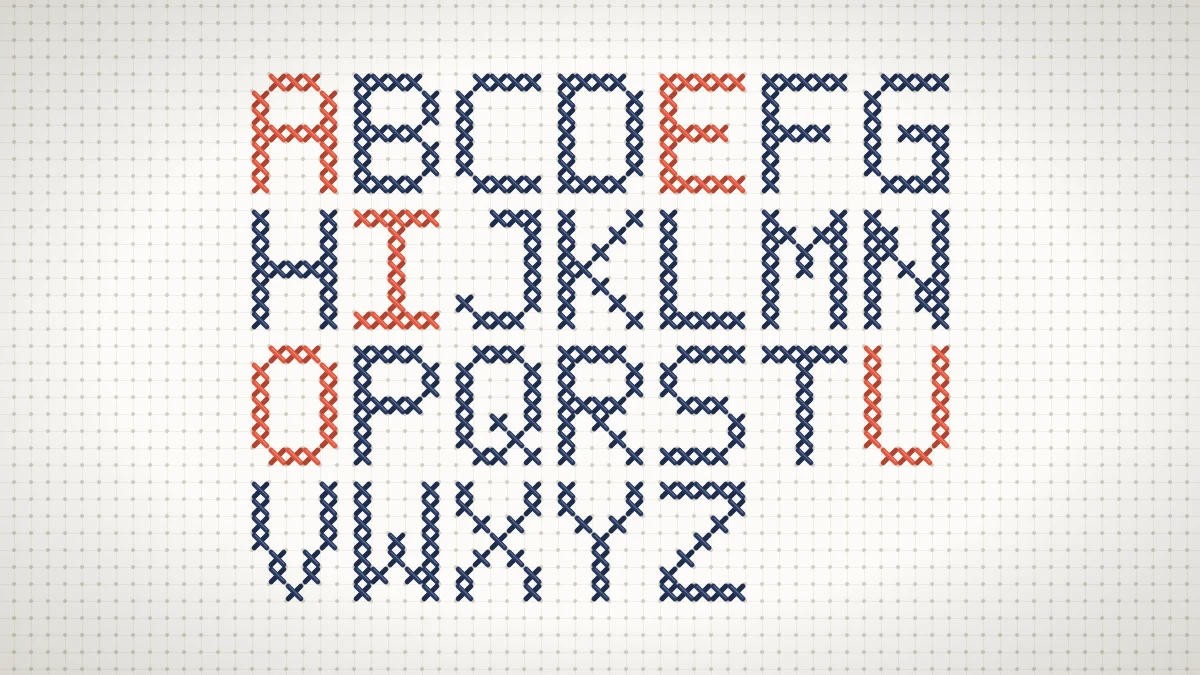
Names, dates, initials, a short word under a motif: sooner or later almost every project needs lettering. This modern cross stitch alphabet is a clean block set of capitals from A to Z, with every letter drawn on the same grid of five stitches wide by seven stitches tall. There are no serifs to count around and no diagonal half stitches, only full crosses, so a name can be planned on paper in a couple of minutes and stitched in an evening or two.
The complete sheet is 41 x 31 stitches with 401 crosses in 2 colors. On the chart the vowels are coral and the consonants navy, simply to make the sheet easier to read; stitch your own lettering in any single color you like.
What Makes This Alphabet Easy to Use
- One size for every letter. Because all 26 letters share the same width and height, the length of any word can be worked out with simple arithmetic before a single stitch is made.
- Straight strokes one stitch thick. Uprights and bars are single rows of crosses. Only the letters that truly need a diagonal, such as K, M, N, V, W, X, Y and Z, use stepped stitches.
- Softened corners. Round letters such as C, G, O and S have their corner squares left empty, which keeps them from looking like boxes and helps tell O from D at a glance.
- Full crosses only. No backstitch is required. If you would rather have very small lettering for a signature or a date, backstitch in cross stitch is the better tool; this alphabet is for words that should be read from across a room.
The Chart
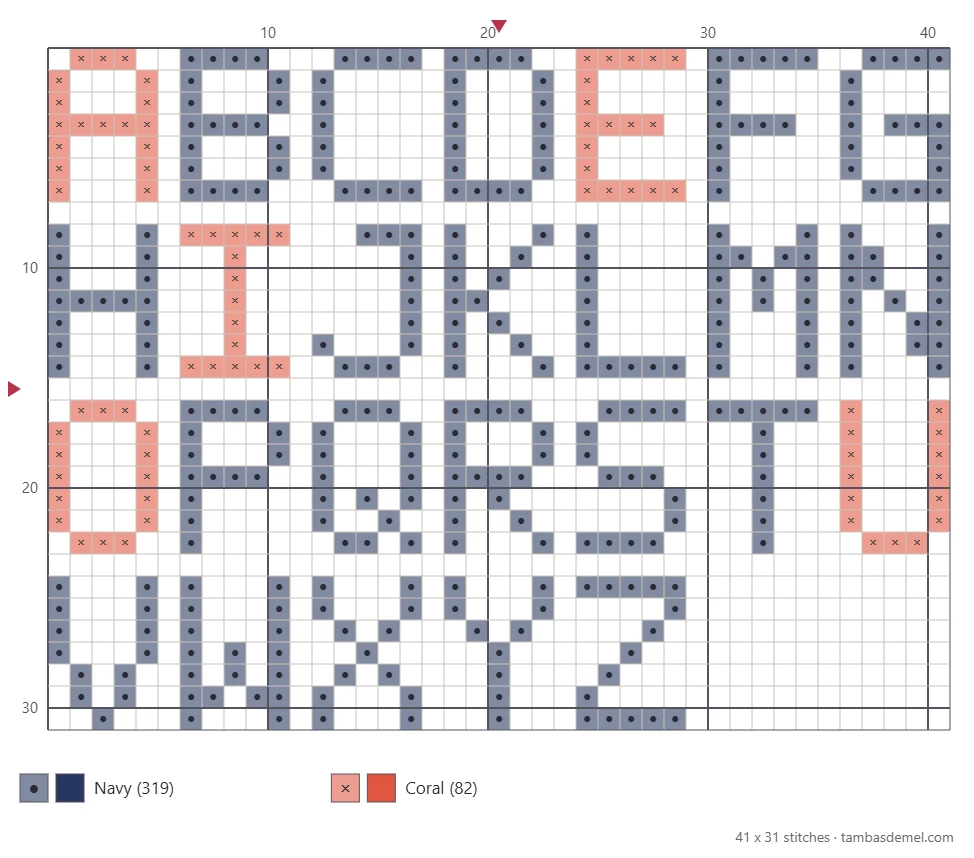
The letters are laid out seven to a row, with one empty square between neighbors. That single empty column is also the standard gap between letters in a word, so the chart shows the spacing exactly as it should be stitched.
Color Key
| Symbol | Color | Stitches |
|---|---|---|
| ● | Navy | 319 |
| × | Coral | 82 |
The stitch totals in the key are for the whole alphabet as charted. For your own text, choose a thread that contrasts strongly with the fabric. Dark navy, charcoal, deep green and berry red all stay legible on white or cream Aida; pale colors make thin letters hard to read.
Materials and Finished Size
- 14-count Aida in white or cream, with 3 in (8 cm) spare on every side of the planned lettering
- Size 24 tapestry needle
- Six-strand cotton floss, 2 strands on 14-count
- Graph paper and a pencil
Stitched exactly as charted, as an alphabet sampler, the sheet measures 2.9 x 2.2 in (7.4 x 5.6 cm) on 14-count fabric.
| Aida | Finished design | Fabric to cut (3 in spare per side) |
|---|---|---|
| 11-count | 3.7 x 2.8 in (9.4 x 7.1 cm) | 10 x 9 in (25.4 x 22.9 cm) |
| 14-count | 2.9 x 2.2 in (7.4 x 5.6 cm) | 9 x 8.5 in (22.9 x 21.6 cm) |
| 16-count | 2.6 x 1.9 in (6.6 x 4.8 cm) | 9 x 8 in (22.9 x 20.3 cm) |
| 18-count | 2.3 x 1.7 in (5.8 x 4.3 cm) | 8.5 x 8 in (21.6 x 20.3 cm) |
A single letter is always seven stitches tall, which is half an inch (1.3 cm) on 14-count Aida.
How to Space a Name
Good spacing is what separates neat lettering from a row of letters. Three rules cover almost every case.
- One empty column between letters. This is the default, and it suits the great majority of letter pairs.
- Three empty columns between words. A gap of three reads clearly as a space without breaking the line apart.
- Two or three empty rows between lines. Two rows keep a name and a date together as one block; three rows give a more open look.
Working out the width
For a single word, multiply the number of letters by 5 and add the number of gaps, which is always one fewer than the number of letters. A five-letter name is therefore 5 x 5 + 4 = 29 stitches wide. Divide by the fabric count for inches.
| Letters in the word | Width in stitches | Width on 14-count |
|---|---|---|
| 3 | 17 | 1.2 in (3.1 cm) |
| 4 | 23 | 1.6 in (4.2 cm) |
| 5 | 29 | 2.1 in (5.3 cm) |
| 6 | 35 | 2.5 in (6.4 cm) |
| 8 | 47 | 3.4 in (8.5 cm) |
| 10 | 59 | 4.2 in (10.7 cm) |
For two words, work out each word separately and add 3 for the space between them.
Centering the text
Once the width is known, halve it to find the middle of the word. If the total is an odd number, the middle is a column of stitches; if it is even, the middle falls on the line between two columns. Match that point to the center line of your fabric or of the motif above, then count outward to the first letter. Draw the whole word on graph paper first: it takes a few minutes and removes all guesswork. The methods in counting cross stitch help when the lettering sits far from the rest of the design.
Tip
Stitch a centered word from the middle outward: the middle letter first, then alternately one letter to the right and one to the left. If a counting slip happens, it affects one letter rather than shifting the whole word off center.
Adjusting awkward pairs
Some pairs of letters leave a visibly larger hole between them even with the standard gap, because one of the letters is open on the side that faces its neighbor. L followed by T or Y, and T followed by J, are typical. If a pair looks loose in your pencil sketch, remove the empty column and let the two letters sit directly side by side; their open shapes keep them from touching. Trust your eye over the rule, and check the sketch from arm’s length.
Monograms and Initials
A monogram is one, two or three initials treated as a small design in their own right.
- Single initial. One letter is small enough to drop into the open center of a motif. It fits neatly inside the floral wreath cross stitch pattern, which leaves a space for exactly this.
- Two or three initials. Use two empty columns between letters instead of one. Initials are read one at a time, not as a word, and the extra air makes that clear. Three initials spaced this way are 19 stitches wide.
- Initials with a divider. Place a single stitch, or a small diamond of four stitches around an empty center, halfway up between two initials.
- Framed monogram. Surround the initials with a narrow band from the cross stitch border patterns, leaving at least two empty rows between the letters and the border on every side.
Stitching Tips for Clean Letters
- Complete each cross as you go in uprights and diagonals, where stitches are stacked or stepped. Use the two-pass method only for horizontal bars.
- Finish the thread after each letter if the next one is in a different color, running the tail under three or four stitches on the back. Within one color, the one-column gap is short enough to cross on the back.
- Do not carry thread across word spaces or between lines on light fabric.
- Keep every top leg slanting the same way. In strokes only one stitch wide, a reversed cross stands out immediately.
Watch out
Check the spelling and the letter order on your graph-paper sketch before stitching, and again after the first two letters. It is easy to reverse the diagonal of an N or the tail of a J, or to stitch an S the wrong way around, when working from the middle of a word outward.
Ideas for Using the Alphabet
- A child’s name under an animal or flower motif for a nursery picture
- Initials and a year in the corner of a sampler
- A single word such as HOME, LOVE or READ as a small framed piece
- A name worked vertically, one letter under another with one empty row between, on the cross stitch bookmark pattern
- Labels for jars, baskets or gift tags on small scraps of Aida
For larger lettering, change the fabric rather than the chart: the same letters come out bigger on 11-count Aida and smaller on 18-count.
Frequently asked questions
How many stitches should be left between cross stitch letters?
One empty column between letters is the usual spacing for a block alphabet of this size, and three empty columns between words. For separate initials in a monogram, two columns between letters looks better because each initial is meant to be read on its own.
How can the letters be made bigger?
The easiest way is to stitch on a lower fabric count: the same chart on 11-count Aida gives larger letters than on 14-count. Another option is to work each charted square as a block of two by two stitches, which doubles both the width and the height.
Does the alphabet have to be stitched in two colors?
No. The two colors on the chart only make the sheet easier to read. Most names and words look best in a single dark color that contrasts clearly with the fabric.
How is a name centered under a motif?
Work out the total width of the name in stitches, find its middle, and line that point up with the center column of the motif. Sketching the name on graph paper first shows the middle clearly and catches spelling slips before they are stitched.