Cross Stitch Needles: Sizes, Types and How to Choose
Which tapestry needle size suits each Aida count, why the tip is blunt, how to thread several strands, and how to tell when a needle is the wrong size.
At a glance
Materials
- Size 24 tapestry needles for 14-count Aida
- Size 22 tapestry needles for 11-count Aida
- Size 26 tapestry needles for 16- and 18-count Aida
- Needle case or strip of felt for storage
- Wire needle threader (optional)
The right cross stitch needles make a quiet but real difference: the thread glides, the holes in the fabric stay their natural size, and the stitches sit evenly. The wrong one snags, squeaks and leaves gaps. Choosing well comes down to two things, the type of needle and its size, and both are easy to get right once you know what the numbers mean.
Why Cross Stitch Uses a Tapestry Needle
Cross stitch on Aida is worked with a tapestry needle. It differs from an ordinary sewing needle in two ways that both matter:
- A blunt, rounded tip. Aida already has a hole at every corner of every block. A blunt tip is guided into that hole by the weave, so the needle lands in the right place almost by itself.
- A large, long eye. Stranded floss is soft and made of several loose strands. A long eye lets two or three strands pass through together without fraying.
The eye is also the widest part of the needle. It opens the hole just enough for the doubled thread behind it to follow without being scraped.
Blunt vs Sharp Needles
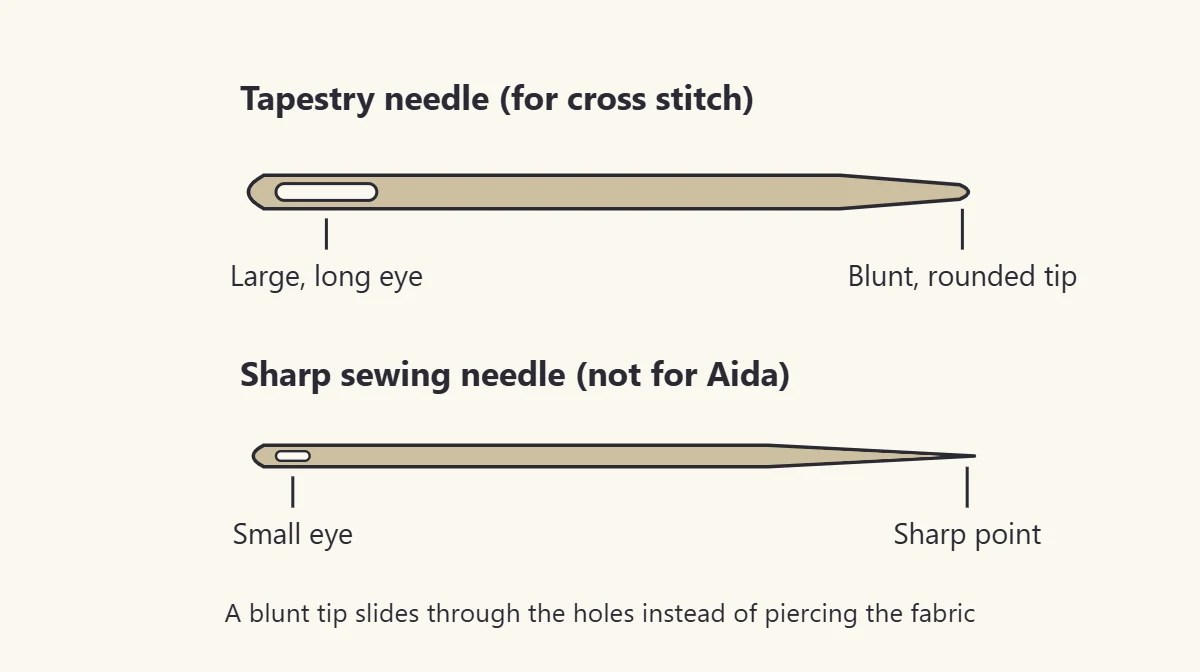
A sharp needle will technically pull thread through Aida, but it creates problems. The point pierces the fabric threads instead of sliding between them, so stitches drift off the grid. It also splits the floss of stitches already made, which roughens the surface and makes mistakes much harder to unpick. And it finds fingertips far more often.
Sharp needles do have a place in needlework. They are the right tool for sewing on beads with a fine beading needle, for stitching on fabrics with no open holes, and for sewing up a finished piece. For the crosses themselves on Aida, stay with a blunt tapestry needle. The same needle works for most outlining too, as explained in backstitch in cross stitch.
Tapestry Needle Sizes for Each Aida Count
Tapestry needles are numbered, and the numbering runs backward from what most people expect: the bigger the number, the finer the needle. A size 22 is thicker than a size 24, and a size 26 is thinner still.
The needle should match the size of the holes in the fabric, which depends on the fabric count.
| Aida count | Tapestry needle size | Usual strands of floss |
|---|---|---|
| 11-count | Size 22 | 3 |
| 14-count | Size 24 | 2 |
| 16-count | Size 26 | 2 |
| 18-count | Size 26 | 1 or 2 |
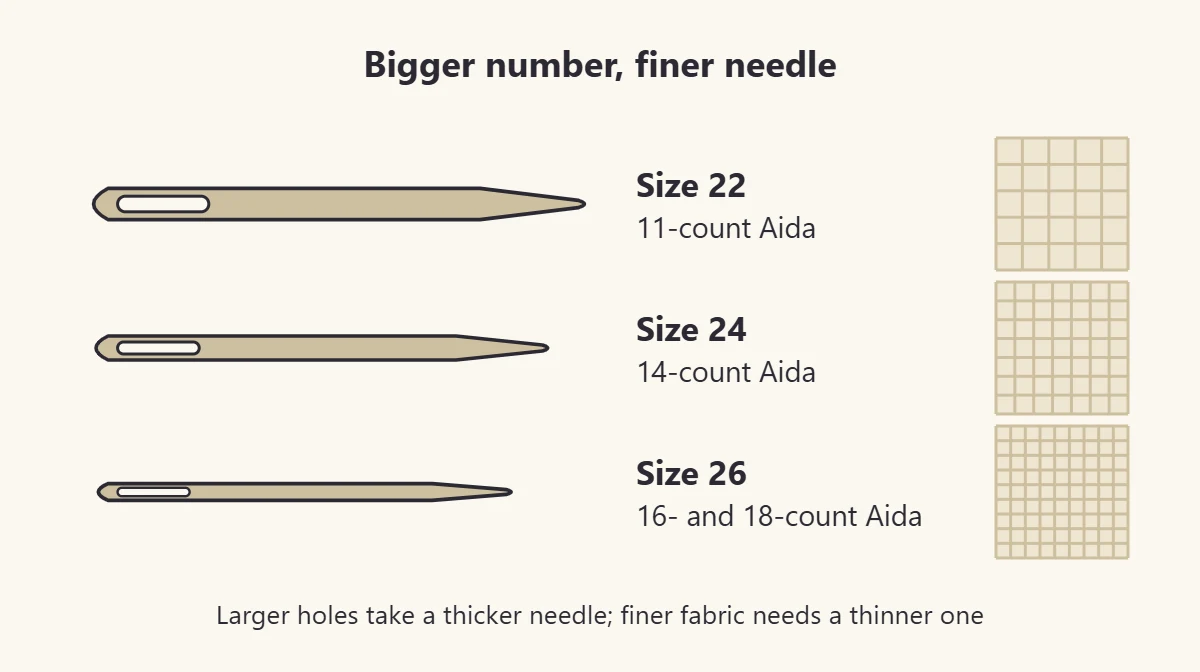
If you are starting on the usual beginner fabric, a size 24 is the needle to have. For what the count numbers themselves mean, see the Aida fabric guide.
Signs Your Needle Is Too Big or Too Small
The size chart is a starting point. The fabric and thread will tell you if something is off.
Too big
- You feel resistance or hear a faint pop each time the eye passes through a hole.
- The holes around finished stitches look stretched, and a little fabric shows at the corners of the crosses.
- The fabric puckers slightly around dense areas.
Too small
- The floss is hard to thread and looks squeezed in the eye.
- The thread drags through the fabric and turns fuzzy or thin before the length is used up.
- The needle slips through so loosely that it is hard to feel where the hole is.
The fix in each case is to move one size in the other direction. A needle that fits passes through with light, even resistance and leaves the hole looking exactly as it did before.
How to Thread a Tapestry Needle
The long eye makes threading easier than with a sewing needle, but several loose strands can still fan out at the wrong moment. Either of these methods works.
The pinch-and-fold method
- Trim the end of the floss so it is clean and square.
- Fold the last inch (2.5 cm) of the floss over the needle and pull it tight to make a sharp crease.
- Pinch the fold firmly between thumb and forefinger so that only a sliver of thread shows, and slide the needle out.
- Press the eye of the needle down over the pinched fold, then pull the loop through.
The flatten-and-push method
- Trim the end cleanly.
- Dampen the tip very slightly and flatten it between your fingers.
- Hold the floss close to its tip and push the flattened end straight through the long eye.
A wire needle threader is a third option and a real help in low light or with fine needles. Whichever method you use, leave a short tail through the eye and do not knot the floss to the needle. Preparing the floss itself, including how to separate the strands, is covered in the embroidery floss guide.
Tip
Slide the needle a little along the thread every so often as you stitch. The eye rubs the floss where it sits, and moving it spreads the wear instead of thinning one spot.
Looking After Your Needles
Tapestry needles are plated, and the plating wears away with use. A needle that has turned dull, rough or slightly sticky drags on the thread and can leave marks on pale fabric. Replace it; needles are consumables, not heirlooms. A needle that has bent is also worth retiring, because it no longer passes straight through the holes.
Watch out
Do not leave a needle parked in the stitching area between sessions. Over time it can stretch the hole or leave a mark that is hard to remove. Park it in the spare margin or in a needle case instead.
Keep spare needles together in a case, a small tin or a strip of felt, sorted by size if you work on more than one fabric count. Loose needles in a project bag are easy to lose and unpleasant to find.
A Simple Starter Set
Nobody needs a large collection. A few size 24 needles cover 14-count Aida, which is where most stitchers begin, and having more than one lets you keep two colors threaded at once. Add size 26 when you try 16- or 18-count, and size 22 if you prefer the larger blocks of 11-count.
With needle and fabric matched, the remaining piece of the puzzle is how firmly to pull each stitch, which is the subject of cross stitch tension. And if you have the supplies but have not made a stitch yet, how to start cross stitch takes you from threading the needle to a finished practice motif.
Frequently asked questions
What size needle do I need for 14-count Aida?
A size 24 tapestry needle is the standard match for 14-count Aida. It carries two strands of floss comfortably and passes through the holes without stretching them.
Can I use a regular sewing needle for cross stitch?
It will pull thread through the fabric, but it is not a good choice for Aida. The sharp point pierces the fabric threads and splits earlier stitches, and the small eye is hard to thread with stranded floss. A blunt tapestry needle is easier and gives neater results.
Why is a size 26 needle thinner than a size 22?
Needle sizes are numbered so that a higher number means a finer needle. It is simply the convention for hand-sewing needles, and it applies to tapestry needles too. Fine fabrics with small holes therefore take higher-numbered needles.
How often should a tapestry needle be replaced?
There is no fixed schedule. Change it when the surface looks dull or feels rough, when the thread starts to drag, or when the needle is bent. A fresh needle is smooth and slides through the fabric with very little effort.


