Daisy Cross Stitch Pattern
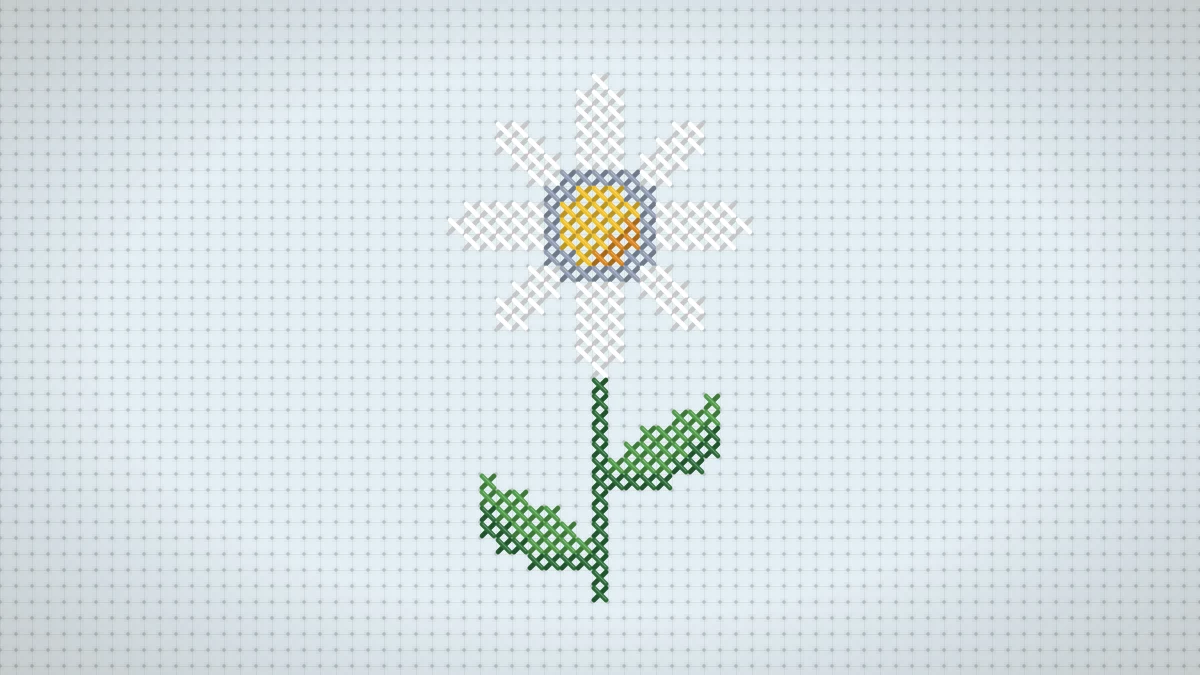
An original daisy with eight white petals, a shaded golden center, a slim stem and two leaves, charted for sky blue Aida so the white petals stand out.
At a glance
Materials
- 14-count sky blue Aida with 3 in (8 cm) spare on each side of the design
- Size 24 tapestry needle
- Stranded cotton floss in white, dove gray, sunny yellow, golden orange and two greens
- Small sharp embroidery scissors
- Embroidery hoop, 5 or 6 in (13 or 15 cm), optional
- Printed chart and a pencil or highlighter for marking progress
White petals, a yellow middle and a thin green stem: a daisy is about as simple as a flower gets, which is exactly why it works so well in thread. This original daisy cross stitch pattern is 19 x 33 stitches and uses 6 colors. Eight petals fan out around a shaded golden center, and two leaves branch off the stem at different heights so the flower does not look stiff.
The one unusual choice is the fabric. The petals are stitched in white, so the design is charted for sky blue Aida. On blue, the white reads at full strength and the gaps between the petals look like sky showing through.
What the Pattern Includes
- Size: 19 x 33 stitches, or 1.4 x 2.4 in (3.6 x 6.1 cm) on 14-count Aida.
- Stitches: 213 full crosses. No backstitch and no fractional stitches.
- Colors: 6 shades: white, a soft gray, two warm yellows and two greens.
- Level: easy. The flower head is the same in all four directions, which makes counting errors easy to catch.
The flower head is built like a compass. Four petals point straight up, down, left and right, and four shorter ones sit on the diagonals between them. A ring of dove gray surrounds the yellow center, shading the base of every petal and stopping the white from running into the yellow.
Materials
- 14-count sky blue Aida with 2–3 in (5–8 cm) of spare fabric on every side
- Size 24 tapestry needle
- Stranded cotton floss in the six colors of the key
- Small sharp scissors
- An embroidery hoop, optional but helpful for keeping white stitches even
Any light-to-mid colored Aida can replace the blue. Soft green gives a meadow feel, though the leaves will stand out less. A natural oatmeal shade gives a rustic look. If Aida is unfamiliar, the Aida fabric guide covers counts and colors.
The Chart
Each square is one stitch. The symbols match the color key printed beside the chart, and the arrows at the edges mark the center lines. Note that the center of the whole design sits below the middle of the flower head, because the stem adds height underneath.
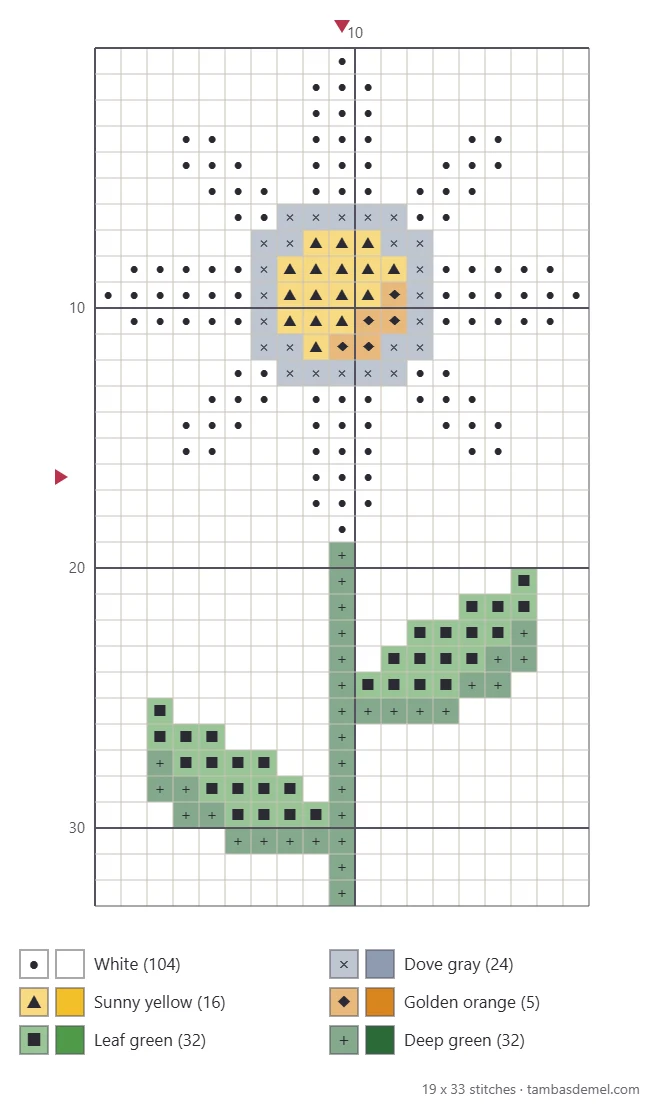
Color Key
Colors are listed by plain name. Match them from the floss you already have, and compare the choices against the fabric, not against a white table: white and dove gray both look different once they sit on blue.
| Symbol | Color | Stitches |
|---|---|---|
| ● | White | 104 |
| × | Dove gray | 24 |
| ▲ | Sunny yellow | 16 |
| ◆ | Golden orange | 5 |
| ■ | Leaf green | 32 |
| + | Deep green | 32 |
The gray should be soft. A gray that is too dark turns the ring into a heavy outline; one that is too pale vanishes next to the white. Hold a strand of each over the fabric and pick the gray that is clearly visible but still gentle.
Finished Size by Fabric Count
| Aida | Finished design | Fabric to cut (3 in spare per side) |
|---|---|---|
| 11-count | 1.7 x 3 in (4.3 x 7.6 cm) | 8 x 9 in (20.3 x 22.9 cm) |
| 14-count | 1.4 x 2.4 in (3.6 x 6.1 cm) | 7.5 x 8.5 in (19.1 x 21.6 cm) |
| 16-count | 1.2 x 2.1 in (3 x 5.3 cm) | 7.5 x 8.5 in (19.1 x 21.6 cm) |
| 18-count | 1.1 x 1.8 in (2.8 x 4.6 cm) | 7.5 x 8 in (19.1 x 20.3 cm) |
Use 2 strands of floss on 14-count and 16-count Aida, 3 strands on 11-count, and 1 or 2 strands on 18-count. White floss on colored fabric benefits from full coverage, so on 18-count 2 strands is the better choice here. If the fabric color shows through the petals on 14-count, check that both legs of each cross are lying flat and untwisted before adding another strand.
Stitching Order
Working from the center of the flower outward keeps every petal the right length. The steps below follow that order.
- Mark the fabric center. Fold the Aida in half both ways. The crossing point of the folds matches the crossing point of the chart’s center arrows.
- Locate the flower center. From the chart, count how many squares the middle of the yellow disc sits above the design center, and count the same number of blocks up on the fabric. The page on counting cross stitch shows how to count across empty fabric without drifting.
- Stitch the yellow disc. Work the sunny yellow first, then the few golden orange stitches that shade its lower right side.
- Stitch the gray ring. Go all the way around the disc in dove gray. When the ring closes neatly on itself, the count is correct.
- Work the four straight petals. Each one grows directly out of the ring and ends in a single stitch at the tip.
- Add the four diagonal petals. They step outward one square at a time. Count each from the ring, not from a neighboring petal.
- Stitch the stem. Start right under the tip of the bottom petal and work the deep green column down to the last row.
- Finish with the leaves. Each leaf has a leaf green body and a deep green underside. The upper leaf points to the right, the lower one to the left.
Tip
Stitch all the white in one sitting if possible, with freshly washed hands. White floss shows handling more than any other color, and a shorter working length of about 18 in (45 cm) keeps it from fraying and turning dull.
Keeping the white stitches smooth
Large areas of a single light color reveal uneven stitches more than dark ones do. Two habits help. First, make every top leg slant the same way across the whole flower. Second, let the needle hang now and then so the floss can untwist; twisted strands cover less fabric and leave blue specks between stitches. The article on cross stitch tension goes into both points.
Watch out
Do not carry green or gray thread across the back behind unstitched fabric or behind white petals. Dark threads can shadow through light stitches. Finish the thread under three or four stitches and restart.
Changing the Colors
The petals are the only part that needs to change to make a different flower:
| Version | Petals | Ring | Suggested fabric |
|---|---|---|---|
| Classic daisy | White | Dove gray | Sky blue or soft green |
| Yellow daisy | Butter yellow | Golden orange | White or cream |
| Pink daisy | Shell pink | Deep rose | White or cream |
| Purple daisy | Soft lilac | Deep violet | White or cream |
For the yellow version, swap the center to a warm brown so it still contrasts with the petals.
A pair of daisies
Two flowers side by side make a wider picture. Stitch the first daisy, leave a few empty columns after its widest petal, and stitch the second one a few rows lower so the heads sit at different heights. Shorten or lengthen either stem by adding or removing rows of deep green at the bottom; the leaves can stay where they are.
Finishing Ideas
- Mount the daisy in a small hoop as a spring decoration, following the steps for finishing cross stitch in a hoop.
- Stitch it on a higher count for a compact motif on a card or gift tag.
- Group it with the tulip pattern for a pair of matching florals of the same height.
- Work only the flower head, without stem or leaves, as a round motif for a pincushion top.
Frequently asked questions
Can this daisy be stitched on white Aida?
Not as charted, because white petals disappear on white fabric. Either choose a colored Aida such as blue, green or a natural oatmeal, or recolor the petals in yellow or pink. On cream fabric, white floss shows only faintly, so a stronger fabric color is the safer choice.
How do I keep white floss clean while stitching?
Wash and dry your hands before each session and keep the working length to about 18 in (45 cm), so the thread passes through the fabric fewer times. Store the project in a clean bag between sessions. A gentle wash in lukewarm water after the last stitch freshens the white.
Why do the diagonal petals look shorter on the chart?
A diagonal step covers more distance than a straight one, so a diagonal petal needs fewer squares to reach the same distance from the center. Counted in squares it is shorter, but measured on the fabric all eight petal tips sit on roughly the same circle.