Embroidery Floss Guide: Strands, Lengths and Storage
How six-strand floss works, how to separate strands without tangles, how many strands to use on each Aida count, and how to store and organize your thread.

At a glance
Materials
- Six-strand cotton embroidery floss
- Small sharp scissors
- Tapestry needle sized to your fabric
- Bobbins, card tags or small resealable bags for storage
- Labels or a pen for marking colors
A skein of embroidery floss looks like a single soft thread, but it is really six fine strands lying loosely side by side. Knowing how to take those strands apart, how many to put back together, and how long to cut them is what turns a tangle-prone thread into smooth, even cross stitches. This guide covers each of those steps, plus simple ways to store and organize a growing collection.
What Six-Strand Floss Is
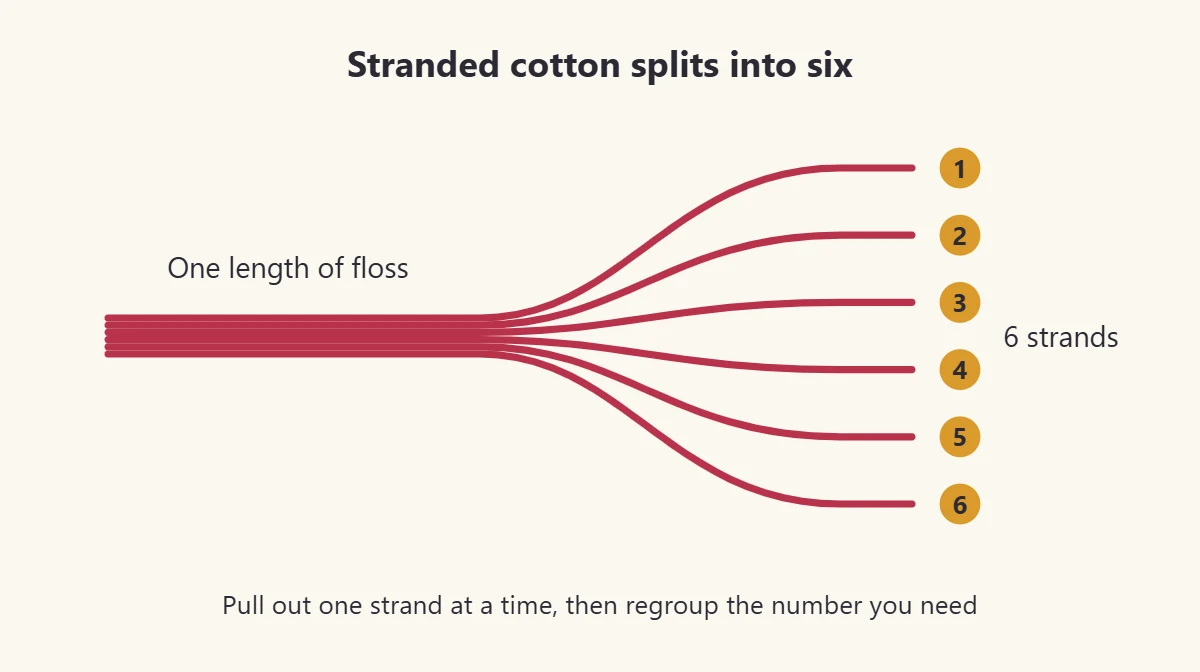
The standard thread for cross stitch is stranded cotton. It has a soft sheen, comes in a very wide range of colors and is sold in small skeins held together by paper bands. Each length is made of six strands that are only lightly twisted around one another, which is why they can be pulled apart.
That divisibility is the whole point. By choosing how many strands to stitch with, you control how thick the stitches are and how completely they cover the fabric. The same skein can produce bold crosses on a coarse fabric and delicate ones on a fine fabric.
How to Separate the Strands
Pulling two strands away from the other four seems like the obvious method, and it is the one that causes knots. Strands separate cleanly only one at a time.
- Cut a length of floss from the skein. Pull gently from the end that slides out freely rather than tugging the whole skein apart.
- Hold the cut length near the top between thumb and forefinger, with the ends of the strands just showing.
- Pick out the tip of one strand and pull it straight up and out. The remaining strands bunch up below your fingers, then fall straight again once the strand is free.
- Lay that strand down and repeat for each strand you need.
- Put the strands back together side by side, with the ends level, and smooth them once between your fingers.
Separating and regrouping is worth doing even when you need most of the strands. Strands that have been pulled apart lie flatter and more parallel than strands still twisted together, so they cover the fabric better.
How Many Strands to Use
The number of strands depends on the fabric count. Bigger blocks need more thread to fill them; smaller blocks need less.
| Aida count | Strands for cross stitch | Strands for backstitch |
|---|---|---|
| 11-count | 3 | Usually 1 |
| 14-count | 2 | Usually 1 |
| 16-count | 2 | Usually 1 |
| 18-count | 1 or 2 | Usually 1 |
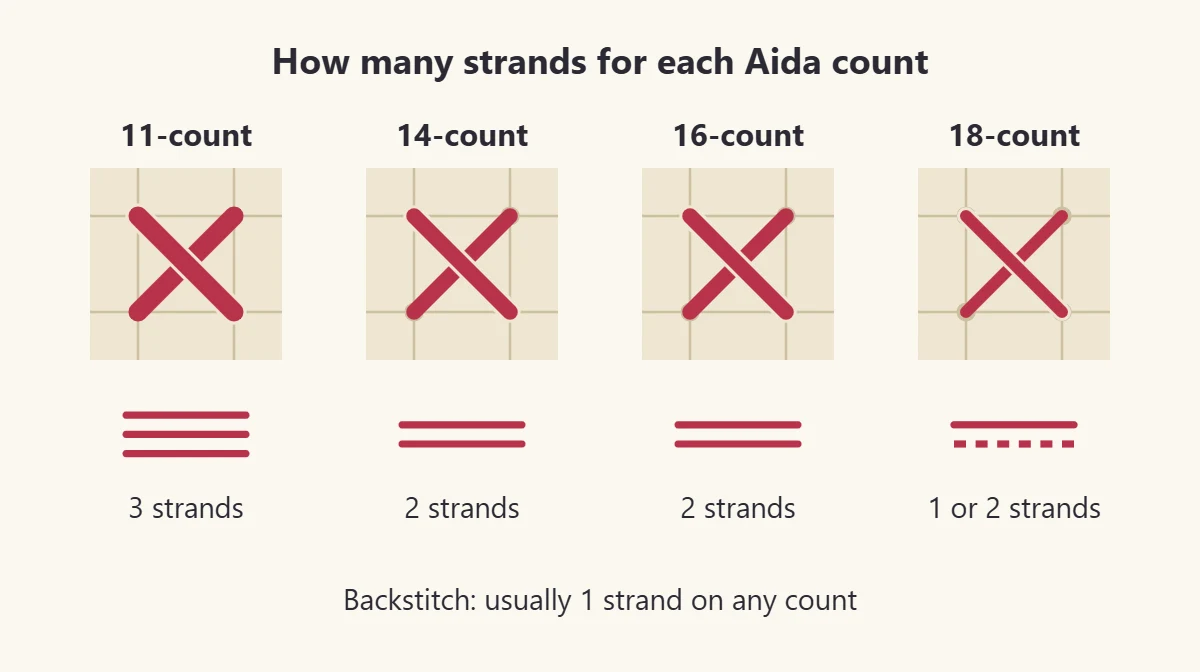
These are the usual choices, not rules. On 18-count, one strand gives a light, airy stitch and two strands give dense coverage; a few test crosses in the margin will show which you prefer. If a pattern states a number of strands, follow the pattern. Fabric counts are explained in the Aida fabric guide, and fine outlines in backstitch in cross stitch.
The Right Working Length
Cut floss to about 18 in (45 cm), roughly the distance from fingertips to elbow. It is tempting to cut longer and rethread less often, but floss wears as it is pulled through the fabric again and again. A long thread turns fuzzy and thin toward the end, tangles more readily and knots itself on the back.
There is one common exception. For a loop start with two strands, cut a single strand about twice the usual length and fold it in half, so that the folded thread is the normal working length. The loop start only works with an even number of strands; it and the other knot-free methods are shown in how to start and finish a thread.
Tip
Floss twists a little with every stitch. When it begins to kink or coil, turn the work over and let the needle dangle. The thread spins back to neutral in a few seconds.
Threading and Keeping Strands Smooth
Thread all the strands through the needle together and leave a short tail through the eye. The needle should be large enough to carry the strands without squeezing them; the sizes that go with each fabric are listed in the guide to cross stitch needles.
As you stitch, the strands should lie next to each other on the fabric like the lanes of a road, not wound around each other like a rope. Flat, parallel strands reflect light evenly and cover more of the block. Untwisting the thread now and then is most of the work; evenness of pull does the rest, and that is covered in cross stitch tension.
Storing and Organizing Floss
A few skeins can live happily in a bag. Once there are a dozen or more, some kind of system saves time and thread. The common options are:
- Bobbins. Each skein is wound onto a small flat card or plastic bobbin and filed in a compartment box. It is tidy and compact, though winding takes time and leaves soft creases in the thread.
- Floss drops or tags. Cut lengths are looped through a hole in a card tag. The thread stays uncreased and is ready cut, which suits a project in progress.
- Small bags. One color per resealable bag, kept on a ring or in a box. Leftover cut lengths go back in the same bag.
- Skeins as bought. Left in their paper bands and stored in a drawer or box. It is the least work, and it suits small collections.
Whatever the method, two habits matter more than the container:
- Label every color. Keep the name you use for it, or the label it came with, attached to the thread. Two similar shades are very hard to tell apart later, especially under indoor lighting.
- Keep leftover strands. When you use two strands of six, the other four are still good. Loop them loosely with the rest of that color for next time.
Watch out
Store floss away from direct sunlight and damp. Strong light can fade colors over time, and thread kept in a humid place can pick up a musty smell that transfers to the finished work.
Having Enough Thread for a Project
Small motifs use only a few lengths of each color, so a single skein of each goes a long way. For a larger design with big areas of one color, it is worth having enough of that color before you begin, because a replacement bought later can differ slightly in shade.
Before starting, lay all the colors together on the fabric you plan to use. This quick check confirms that each one contrasts with the fabric and with its neighbors, and it is far easier to swap a shade at this stage than after it has been stitched.
Frequently asked questions
How many strands of floss do I use for cross stitch?
It depends on the fabric count. Two strands is the usual choice on 14-count and 16-count Aida, three on 11-count, and one or two on 18-count. If a pattern gives its own number, use that.
Why does my floss keep tangling?
The most common causes are a thread that is too long and strands that were pulled apart in a group instead of one at a time. Cut to about 18 in (45 cm), separate every strand individually, and let the needle hang now and then so the thread can untwist.
Should I wind floss onto bobbins?
Only if the system appeals to you. Bobbins are compact and easy to sort, but winding takes time and creases the thread slightly. Tags, small bags or the original skeins all work just as well when every color stays labeled.
Can I use the leftover strands?
Yes. Strands left over after separating are exactly the same thread and can be used for the next length. Keep them with the rest of that color so they do not get mixed up with a similar shade.


